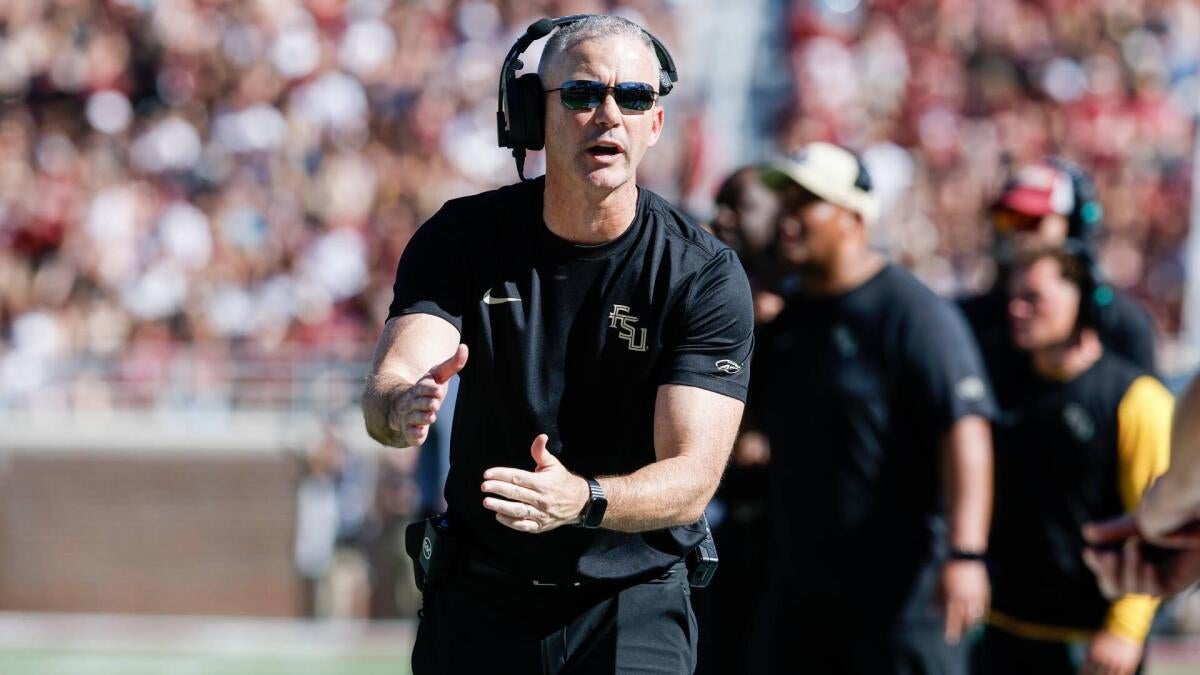
In college football, the buyout clause is often the most critical financial line item in a coach's contract. Sticker-shock numbers dominate headlines: Jimbo Fisher's fully guaranteed $76.8 million from Texas A&M, Gus Malzahn's $21.4 million from Auburn, and Ed Orgeron's $17.1 million from LSU. But at the lower-paid levels of the sport, the calculus is vastly different.
The Mitigation Clause
When Sam Houston fired offensive coordinator Phil Longo in late October, his contract revealed the mechanics of a small-school buyout. Longo's 2025 salary was $725,000, with a maximum of $950,000 including incentives. He is owed the remainder of his 2026 salary plus base salaries for 2027 and 2028 — roughly $1.53 million total — plus $50,000 in supplemental income, paid monthly. The key figure, however, lies in the mitigation clause. For every dollar Longo earns from a new coaching job through the end of his contract, Sam Houston reduces its buyout payment dollar-for-dollar. If he lands a Power Four coordinator role paying more than the owed amount, the school could owe nothing.
Offset Clauses and School Tactics
Such offset clauses are now boilerplate, designed to prevent a Texas A&M-style situation. Many contracts also include a duty-to-mitigate clause requiring coaches to seek work in good faith. Schools have sharpened their language to prevent coaches from structuring new deals to game the offset — for example, front-loading or back-loading salary to manipulate the mitigation math. One industry source described the school as "the bank" that will "nickel and dime you on everything," even requesting tax returns to verify income.
Financial Pressures and Ticket Revenue
The decision to fire a coach goes beyond wins and losses. Athletic directors weigh political capital, overall budget, and revenue generation. Wyoming's Jay Sawvel donated $125,000 to his program's NIL budget, mirroring Mike Norvell's $4.5 million commitment at Florida State. At the Group of Six level, where the median athletic department budget is around $44 million (Sam Houston's expenses were $42 million in fiscal 2025), ticket revenue is critical. Consultant KC Smurthwaite notes that schools losing $100,000 per home game due to fan apathy may find a $1.5 million buyout cheaper than retaining an unpopular coach. "Can we actually just make that money back with the opportunity cost?" Smurthwaite asks. The coaching carousel spins at every level, but the ride is expensive whether in College Station or Huntsville.

